Assam Flood 2026 Relief & Transparency Portal
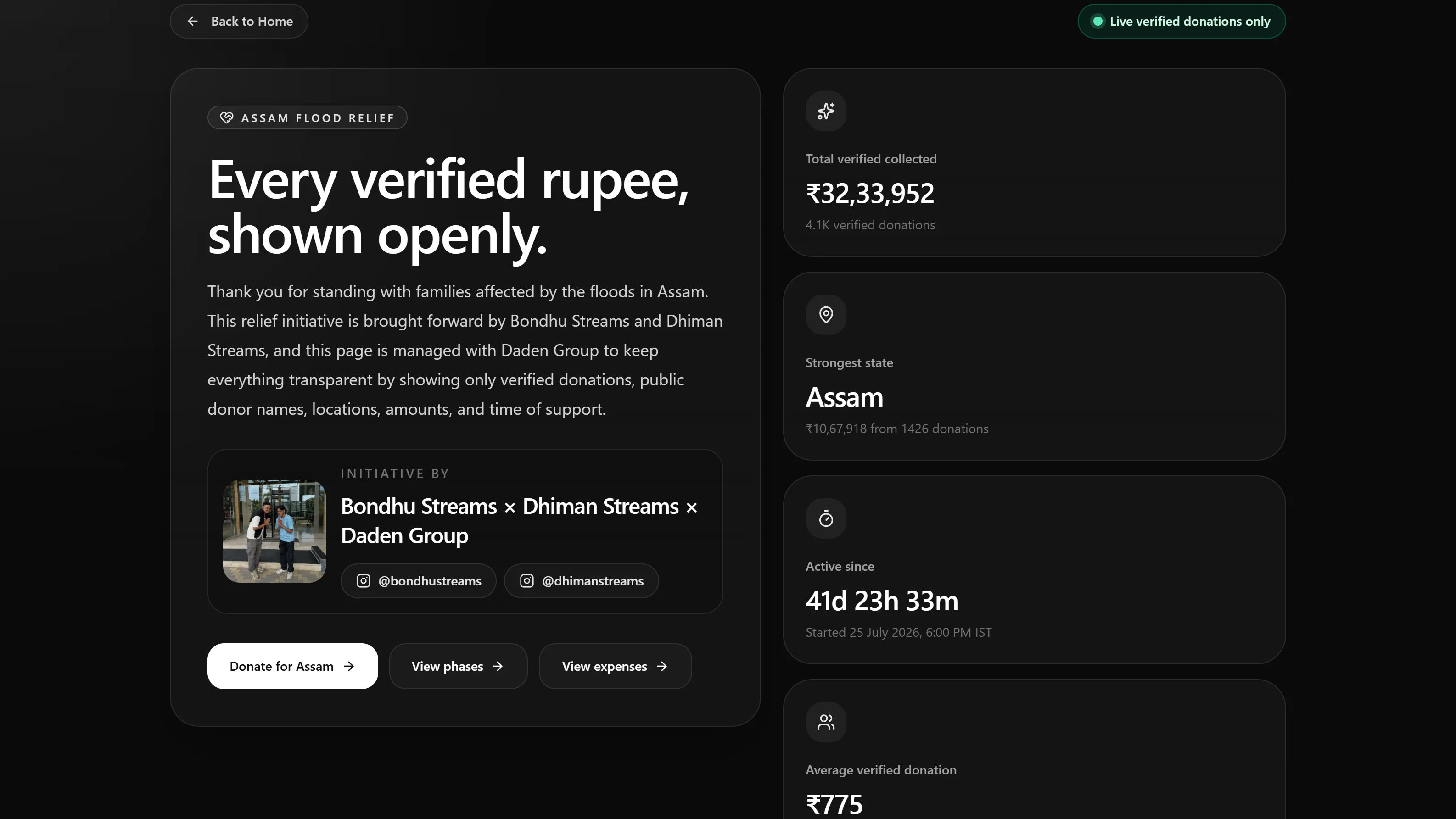
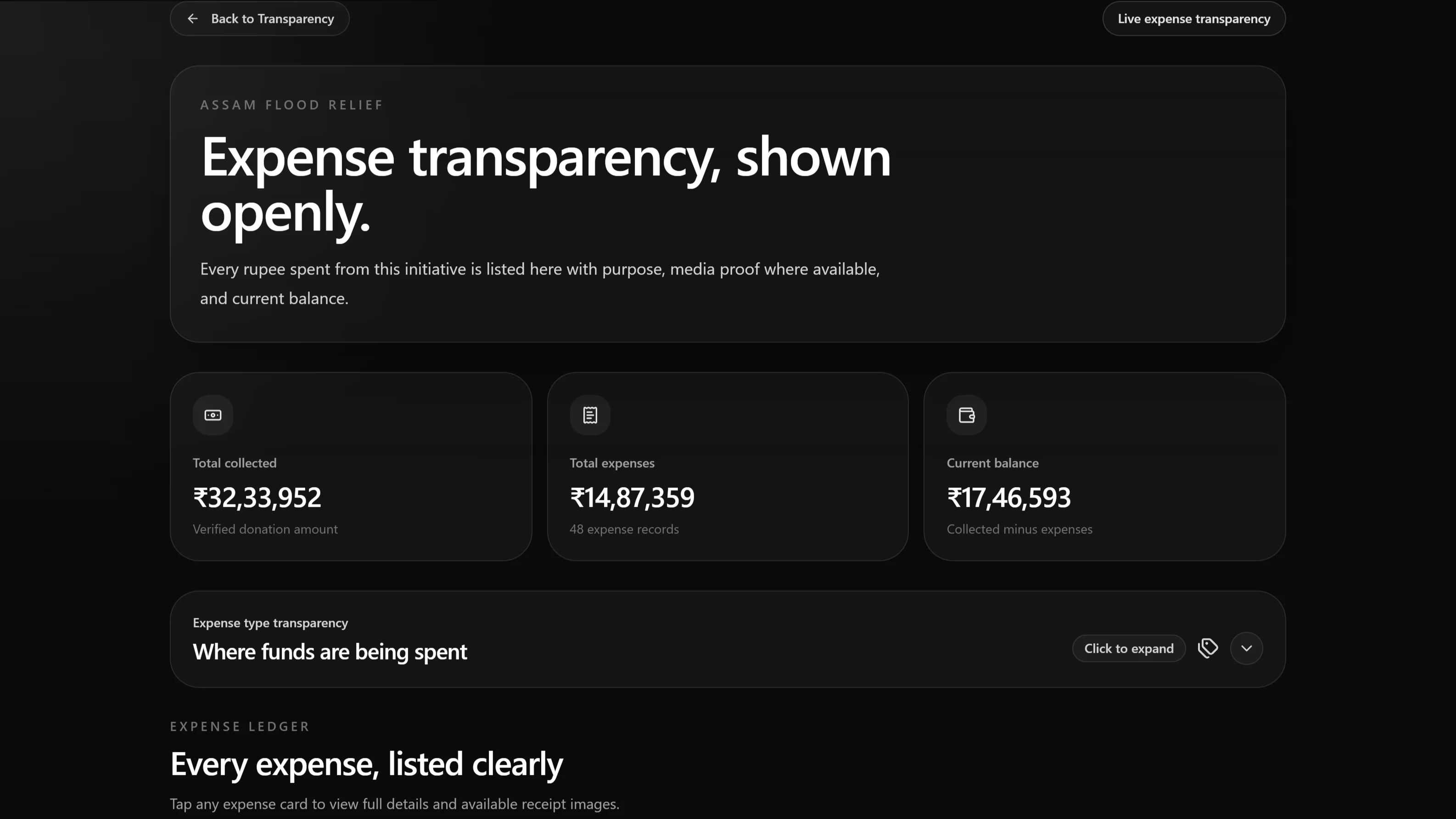
Enterprise system architecture flowchart and real-time public donation ledger engineered by me for the Bondhu Streams x Dhiman Streams x Daden Group disaster relief initiative. Featuring connected routing paths, live animated packet simulation across MongoDB, Express, Razorpay webhooks, sub-50ms RAM caching, and Zero-PII donor privacy.
Database
MongoDB
Payment Lifecycle
Razorpay Webhooks
Polling Interval
Every 3 Seconds
Abandoned Cleanup
24h Auto-Purge
Connected Architecture Flowchart & Live Packet Simulation
Enterprise schematic showing connected routing paths. Click Play Flow Simulation to watch glowing data packets travel across the architecture in real time.
[ROUTING STEP 1/7]: 1. Form Submission & API Request
[FRONTEND ➔ API GW] User submits donation form. POST /api/donate payload transmitted with CSRF token and rate-limit headers.
The Crisis & The Technical Challenge
During the devastating Assam Flood 2026, time was measured in minutes. Bondhu Streams, in collaboration with Dhiman Streams and Daden Group, launched a massive statewide fundraising campaign to channel emergency financial aid directly to stranded flood victims.
As the sole Chief Technology Officer and architect behind this initiative, I was tasked with engineering a bulletproof technological infrastructure from scratch. The system needed to ingest thousands of simultaneous payment requests from diverse geographic locations, reflect live donations instantly on the public frontend, maintain absolute financial accountability, and safeguard donor data privacy all under extreme public scrutiny and zero-downtime requirements.
Core Systems Architecture & Stack
A production environment handling real humanitarian funds cannot afford brittle abstractions. I engineered a lean, highly optimized tech stack designed for raw throughput and minimal server resource utilization:
Frontend (React Polling UI)
Built with a high-performance React UI executing a 3-second polling loop to fetch and render live donation updates instantly across mobile and desktop devices.
Backend & Webhooks (Express.js)
An asynchronous Express.js API layer managing security validation, Razorpay webhook signature verification, transaction validity state machines, and cache invalidation.
MongoDB & Backend RAM Caching
Persistent storage in MongoDB for financial logs and pending/valid states, paired with an in-memory Node.js RAM cache that serves public poll requests instantly without DB lookups.
Zero-PII Data Privacy & Security
Strict input sanitization, API boundary stripping, and encrypted storage protocols ensuring sensitive donor PII (phone numbers, emails) never touched public endpoints.
Engineering Highlights & Technical Triumphs
01 Razorpay Webhook Lifecycle & Invalid-to-Valid DB State Transition
When a user submits their donation details, the system writes a record to MongoDB with an initial invalid/pending state and opens the Razorpay checkout modal. Only when Razorpay's server-to-server webhook successfully fires with a verified payment signature does the backend transition the entity to a valid state in MongoDB. Unpaid or abandoned intents remain invalid and are automatically purged after 24 hours.
02 3-Second UI Polling Powered by RAM Cache
To create a live, real-time feel on the frontend without WebSocket overhead or database saturation, the client polls the backend every 3 seconds. Because the backend serves this response directly from the Node.js RAM cache, database query load is reduced by over 98%, ensuring instant sub-50ms responses even when thousands of users are viewing the ledger simultaneously.
03 Absolute Donor Data Privacy & Regulatory Compliance
Financial transparency must never compromise donor privacy. I designed strict schema boundaries and serialization middleware that automatically strips sensitive Personally Identifiable Information (PII) such as phone numbers, email addresses, and payment gateway tokens before data ever reaches the public JSON response buffers. Only verified donor names, contribution amounts, and timestamps were rendered on the public transparency feed.
Why Real Systems Engineering Cannot Be "Vibe-Coded"
In modern software development, AI tools and "vibe coding" can rapidly scaffold static UI components or basic templates. However, when real money, high-concurrency traffic, live humanitarian relief funds, and zero-downtime deployments are on the line, AI assistance accounts for barely 10% of the solution.
Designing and deploying the Bondhu Streams platform single-handedly required rigorous manual engineering discipline:
- Architecting atomic MongoDB state transitions from
pending/invalidtovalidupon cryptographically verified Razorpay webhooks. - Implementing automated 24-hour cleanup worker cron jobs to purge abandoned payment intents from MongoDB.
- Engineering memory-safe backend RAM caching layers with immediate cache invalidation and refresh cycles.
- Optimizing 3-second frontend polling intervals to balance real-time freshness against server throughput.
Handling this level of financial and system architecture responsibility entirely alone at 19 is what separates theoretical knowledge from battle-tested systems engineering.
Frequently Asked Questions (FAQ)
Key insights into the technology, operational decisions, and public transparency mechanisms behind the Assam Flood 2026 Relief Portal. Click any question dropdown to read details.
Ready to build your next high-impact system?
Let's discuss how robust architecture can scale your business.